The golden rule of MCM in a living room: you do not need matching sets. You do not need teak, walnut, or rosewood on every single surface. You need the right silhouette language, one or two warm wood tones that play well together, and at least one seat color that did not pass a focus group review. The rest is editing.
Start with the seating silhouette
The thing that makes a chair read mid-century is not the color or the material. It is the leg: splayed, tapered, lifted off the ground at an angle that gives the chair a lively, slightly leaning-forward look. This is why a mustard velvet chair on black hairpin legs reads more MCM than a walnut chair on a solid plinth base. Get the leg right and you get the era.
The second silhouette rule is the seat back. MCM seats are often relatively low and wide, with tight upholstery that does not suggest you are about to sink into a cloud and never be seen again. Comfort lives in the seat cushion, not the back height.
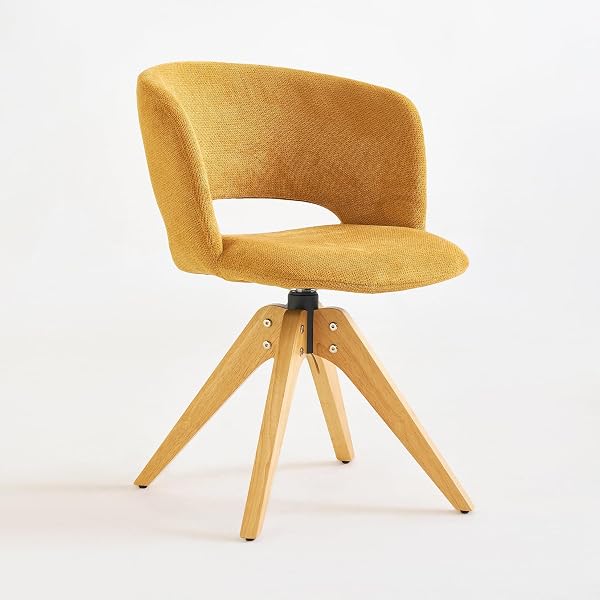
Mustard Swivel Chair on Splayed Oak Legs
What it is Curved-back swivel in mustard linen on splayed oak legs. Low, compact, the perfect silhouette: curved back, good leg angle, no wheels to break the look.
Style it Pair with a walnut side table and a single arc lamp. This is the accent chair that makes the sofa look more interesting by proximity.

Green Corduroy Armchair with Solid Wood Frame
What it is Wide-wale corduroy on a solid wood frame, with lumbar pillow and tapered legs. Green corduroy is the most MCM material combination since walnut and leather.
Style it Put it at an angle to the sofa with a tray table beside it. It reads like a piece you inherited from someone with better taste than you.
The credenza is doing more than you think
In a MCM living room, the credenza is not storage. It is the horizontal line that anchors the room. It says: things are organized here. Someone made a decision about this wall. The legs matter as much as the cabinet itself. Low, long, and lifted off the floor is the formula. If you can see daylight beneath it, you are doing it right.

Bifins 55" MCM Sideboard, Oval Doors
What it is 55-inch sideboard with oval-cutout cabinet doors and tapered legs lifted off the floor. Warm oak tone. The oval cutout is where the design lives.
Style it Art above, three objects on the surface: one tall, one medium, one small. That is the credenza formula for every MCM room it has ever worked in.
The rug ties the era together
A MCM room with no rug looks unfinished. A MCM room with the wrong rug (shag, jute, too pale and barely there) looks like a mistake. The right rug has geometry: diamonds, stripes, a repeating grid, or an abstract graphic pattern in two or three colors. The rug is where the era asserts itself on the floor.

Geometric Squares Rug, 5x7
What it is A flat-weave rug with a geometric grid pattern in teal, amber, and cream. 5x7, enough to ground a seating group without hiding all the floor.
Style it Front legs of seating on the rug, back legs off. This is not a rule, it is just what makes rooms look designed rather than assembled.
The storage piece that stores and also does architecture
If your living room has a dedicated display or storage wall and you want it to read MCM, the best move is an arched bookshelf. The arch reads mid-century and also solves the problem of a short, wide shelf that makes a tall wall look accidental. An arch points up. It gives the eye a reason to travel.

Janmer 79" Walnut Arch with Tambour Doors
What it is A 79-inch walnut arched bookshelf with four open display tiers at the top and sliding ribbed tambour doors at the bottom. The arch is the structure, the tambour is the material moment.
Style it Odd numbers on every shelf: three objects, five books, one sculpture. The tambour doors hide whatever needs hiding. The arch does the architecture.
What not to do
Do not buy a "MCM-inspired" bedroom set where the nightstand, dresser, and bed frame match exactly. Matching sets are a furniture-store convention, not a design one. Real mid-century rooms were assembled over time by people who found good chairs and good tables separately. The eclecticism is the point.
Do not skip the lamp. A room lit only by an overhead fixture cannot be MCM regardless of what furniture is in it. The era invented the floor lamp as a room element, not a utility. Put a lamp in the reading corner, put a lamp by the credenza, and turn off the overhead by 6pm.
And do not choose "safe" colors because you are afraid. Mustard, green, teal, coral: these are the MCM palette. One of them, properly placed, is what takes a room from "I have good furniture" to "I have a point of view." The full MCM edit has the specific pieces that get there.