Walk into a room lit by one ceiling fixture and your brain knows something is off before you do. Everything is evenly, fairly, democratically lit, which is exactly how no beautiful place on earth has ever been lit. Restaurants know this. Hotel bars know this. Your living room, blasted from above like a parking garage, has not been told. The fix costs less than a dinner for two and takes one evening.
Why the big light ruins everything
Light from directly above flattens faces, deletes shadows, and pushes every corner of the room into the same dull importance. Shadows are not the enemy. Shadows are depth, and depth is what makes a room feel like a place instead of a storage unit with a sofa in it.
There's a biological layer too: bright downward light reads as noon to your body. Run it until bedtime and you've spent the whole evening telling your nervous system it's lunchtime. Lamps at eye level and below read as sunset, which is the setting a living room is for.
The three-source rule
Every room that feels good has at least three light sources below eye level. Not two, which reads as a power outage with survivors. Three: typically one floor lamp, one table lamp, and one wildcard, a shelf lamp, a sconce, a glowing object, candlelight. Spread them in a rough triangle so the room has pools of light with comfortable shadow between them.
Pools are the entire trick. A room lit in pools invites you to move between them: reading happens here, conversation happens there, and the room composes itself into zones without a single piece of furniture moving.
The bulb number that changes everything
Flip the box over and find the color temperature. You want 2700K, warm white, the color of late afternoon. 3000K is acceptable in a kitchen. Anything labeled "daylight" or 5000K belongs in a dentist's office and nowhere you intend to relax, ever.
And get every bulb in the room to the same temperature. One cool bulb in a warm room is like one person clapping off-beat: technically a small problem, somehow the only thing you can notice.
Lamps that do something to the light
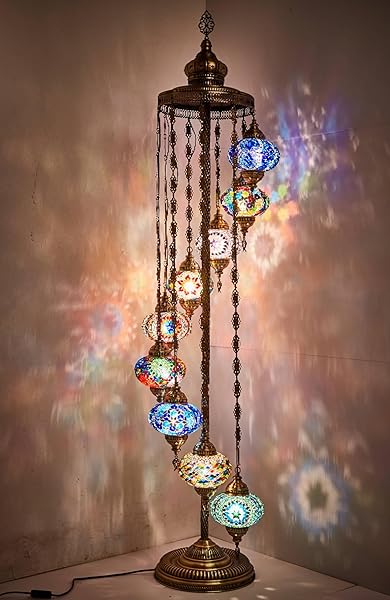
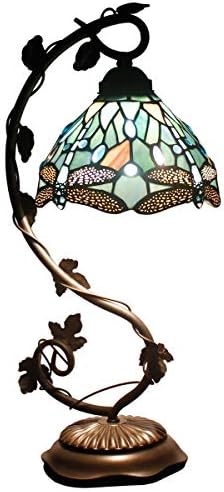
Once the basics work, the upgrade is lamps that edit light instead of just emitting it. Fabric shades soften it. Amber glass warms it twice, at the flame and in the base, which is why the candle holders in The Cold Living Room Rescue Kit punch so far above their size. And stained glass turns a plain bulb into colored weather moving across the wall, which is the whole argument of The Stained Glass Revival. A lamp that performs is doing decor and lighting at the same time, two jobs, one cord.
The renter's version
No wiring, no permission needed (the whole deposit-safe playbook is in How to decorate a rental). Plug-in lamps cover almost everything: floor lamp, table lamp, done. For the wildcard, battery and rechargeable lamps now hold a charge for weeks and go on shelves no outlet can reach. Even sunlight can be conscripted: a sheet of rainbow window film from the Under-$50 Hall of Fame turns your one good window into a daytime light fixture for single-digit money.
If the budget is tight, fix it in this order: warm bulbs first, they're nearly free. Then one good table lamp. Then build toward three sources, raiding the lighting shop as funds allow. A cold grey room gets fixed in the same order, light is step four of that plan for a reason.
That's the system: three sources, one triangle, 2700K, and at least one lamp with a personality. The big light still has a job. The job is finding your keys. Ready to shop? The vetted floor lamp shortlist, organized by job, is in The Floor Lamp Edit. Taking the system outside? The outdoor version, including 23,000-reviewed dimmable string lights, is in The Summer Hosting Kit.